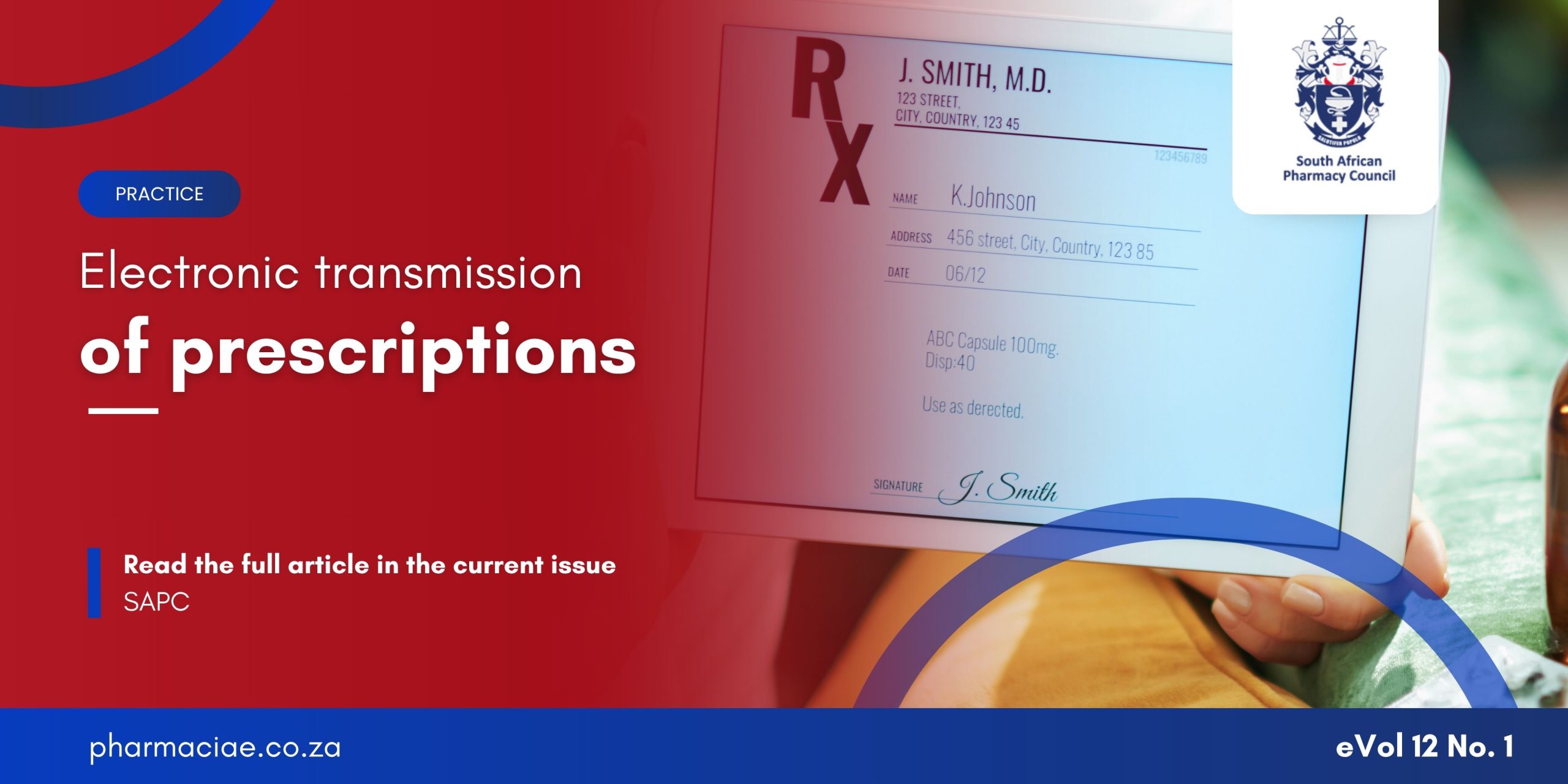
Electronic transmission of prescriptions
Guidance on complying with Regulation 33 of the General Regulations and the Rules relating to Good Pharmacy Practice when dispensing e-prescriptions.
Pharmacy hopping and prescription forgery presents renewed risks for the pharmacy profession as the adoption of e-prescribing and the electronic transmission of prescriptions become more common in South Africa. This article provides guidance to the pharmacy profession to ensure compliance the Rules relating to Good Pharmacy Practice and other relevant legislation when it comes to dispensing electronic prescriptions.
Handling electronic prescriptions
Council has observed that there are various electronic prescribing platforms available in South Africa allow for different functionalities, and that their adoption and use may vary, posing a risk of non-compliance with legislation, pharmacy hopping and prescription forgery. Council has thus come to the conclusion that there is a need for guidance to the profession to assist pharmacists and their support personnel when dispensing electronic prescriptions. This article is supplementary to an article on this subject published by Council in Pharmaciae Vol. 9, No 1 in December 2026, which may be found here, and contains the most current position on e-prescriptions and their transmission to the pharmacy for dispensing.
Regulation 33 of the General Regulations (2017) published in terms of the Medicines and Related Substances Act, 101 of 1965 (hereafter “General Regulations”), allows for electronic signatures and the electronic transmission of prescriptions. In particular, Regulation 33(5) provides that “in the event of a prescription transmitted electronically by means other than an electronic agent, by fax or communicated verbally, a permanent copy of the prescription shall be made for record purposes”.
Consideration of legislative requirements for e-prescription validity
Regulation 33(1)(c) of the General Regulations provides that “every prescription for a medicine shall be prepared with an electronic agent as defined by and in compliance with the Electronic Communications and Transactions Act, 25 of 2002”, while Regulation 33(5) provides that “in the event of a prescription transmitted electronically by means other than an electronic agent, by fax or communicated verbally, a permanent copy of the prescription shall be made for record purposes”.
Section 14 of the Electronic Communications and Transactions Act, 25 of 2002, providing for the facilitation and regulation of electronic communications and transactions, describes an “original” as follows:1) where a law requires information to be presented or retained in its original form, that requirement is met by a data message if-
(aa) the integrity of the information from the time when it was first generated in its final form as a data message or otherwise has passed the assessment in terms of subsection (2); and
(bb) that information is capable of being displayed or produced to the person to whom it is to be presented.
2) for the purposes of subsection 1(a), the integrity must be assessed-
(aa) by considering whether the information has remained complete and unaltered except for the addition of any endorsement and any change which arises in the normal course of communication, storage and display;
(bb) in the light of the purpose for which the information was generated; and
(cc) having regard to all other relevant circumstances.
Thus, so long as a prescription meets the above criteria it ought to be considered by the pharmacist for dispensing subject to the relevant verification and authentication as required by Regulation 33(4) of the General Regulations and the Rules relating to Good Pharmacy Practice, in particular the Minimum standards for the dispensing of medicine or scheduled substances on the prescription of an authorised prescriber.
The pharmacist’s responsibility to verify e-prescriptions
To ensure compliance with the requirements the General Regulations and the Rules relating to Good Pharmacy Practice, e-prescriptions should be transmitted directly from the verified email addresses or prescribing platforms of authorised prescribers. Where such are not verified, the prescription lacks key information required by legislation, or is transmitted by the patient, the onus is on the pharmacist to verify such prescription prior to dispensing.
The South African Pharmacy Council does not promote any business model for e-prescribing or advanced electronic signatures and cannot be involved in the process of selecting a prescribing/dispensing platform.
Council has noted the profession’s concern regarding “pharmacy hopping” by patients to have the same prescription dispensed multiple times using electronic prescriptions, as some patients request a copy of their electronic script, which has been transmitted by the doctor to the pharmacy. Where an e-prescription is presented by a patient, the verification of its dispensing status with the prescriber or their prescribing platform is essential; alternatively, the patient may be requested to initiate the direct transmission of the prescription to the pharmacist.
It is best practice that legitimate prescriptions are transmitted only from an authorised prescriber directly to the pharmacy, and that to protect the public, the profession must decline any prescriptions transmitted to them by the patients if these cannot be verified by the pharmacist.
Advertisement